Wednesday, 10 December 2014
13 Toddler-Approved Picture Books
In Shabdita's first year, we read to her intermittently. She enjoyed it, and I bought a variety of books for her, but we were not able to get a routine going where we would read to her everyday. I started reading to her regularly in Canberra as a way of keeping her busy, and realised too late that reading aloud to her actually keeps me busy all the time. We've now settled into a routine that is no routine. Any time during the day, she will come up to me or Vipul holding out a book and saying 'wooooords'. She is ready to listen to 'words' any time and has firm likes and dislikes. Sometimes she listens to the entire story, rapt in attention; at other times, she quickly turns the pages and wants to finish a lot of books in a little time. Sometimes she says 'bye' to the pages that she wants to skim, seeming to know that she is just passing them by. I like most of these books, though reading them over and over again can rob them of their charm. On some days, I'm so 'read out' that I never want to see a book again. Without further ado, though, here is a list of those picture books that she returns to most often. If you have young kids or are looking to become a favourite uncle or aunt, this list may help. Some of these are books that you and I may not see the appeal of, but have the seal of approval from a two year old 'discerning' listener.
1. Where's Spot? by Eric Hill
This is the first book that Shabdita took to. She loves raising the flaps and saying 'noooooo' as loudly and dramatically as she can. She waits for the roaring 'no' and the hissing 'no'.
2. Blueberry Girl by Neil Gaiman (author) and Charles Vess (illustrator)
'Ladies of light, and ladies of darkness, and ladies of never you mind"... I love this book for so many reasons. For the fact that the Blueberry girl is not white, and she is different ages across the book. For the myriad creatures on its pages, from the owl that accompanies her everywhere to the whale on whose back she sits. For the line "Ladies of paradox, ladies of measure, ladies of words that fall". For the fact that when I ask Shabdita, "who's my Blueberry girl?", she points to herself proudly. For fans of Neil Gaiman, you can listen to the entire book, read by Neil himself, in this YouTube video.
3. Goodnight Moon by Margaret Wise Brown (author) and Clement Hurd (illustrator)
This one is a calming read. I like the fact that there is a moon outside the window, and there is a moon in the picture inside the room. One moon is waxing, and the other is waning. I think that this book can be opened up for conversations about the many different kinds of moons, about reality and representations, when Shabdita is older.
4. Big Red Barn by Margaret Wise Brown (author) and Felicia Bond (illustrator)
This one has Shabdita all excited because it has two cows. There are horses and pigs too, but to her they are all 'cow'. There are also cats, dogs, geese, hens, field mice and even bats. And they all sleep in the night, except the bats, which means that the last few pages are whispered, and that adds to the excitement of the book. Honestly, this book does not exactly set my world on fire, but it is a good introduction to animals I guess. She really likes it and brings it to be read regularly. Seeing her excitement, I considered how to show her an actual living cow, and realised depressingly that I'll have to find a farm that takes visitors and take her there. Sigh. If we'd been in India she could have seen cows everywhere, and while that may have made them less exciting, it is not such a great thing that she should drink milk everyday thinking that it comes from the neighbourhood supermarket.
5. Little Green by Keith Baker
Shabdita loves watching birds and enjoys making marks, with pen or pencil, on whatever surface is available. This book brings together both these things, a bird and a boy who is painting the way in which the bird flies, and does it in the most gentle manner possible. I love it too and don't mind multiple readings, and Shabdita especially likes the part where she gets to turn the book around to see the bird hovering up in the air. Trying to find the earthworm on all the pages is a bonus.
6. There's A Hippopotamus on our Roof Eating Cake by Hazel Edwards (author) and Deborah Niland (illustrator)
Its quite a mouthful of a title and features an older child, who invents an omnipotent hippopotamus friend who gets to do everything that she doesn't, like eating cake, watching tv and riding a bike. Shabdita absolutely loves this book right now, though I am doubtful of how much she actually comprehends. I think her obsession with the book may have a lot to do with the sound of the word 'hippopotamus'.
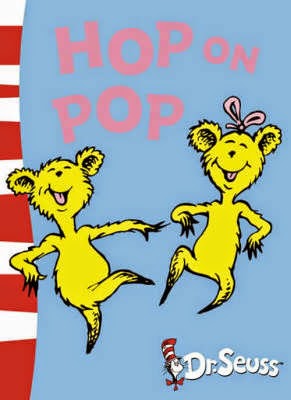
7. Hop on Pop by Dr. Seuss
Shabdita likes this book because she can already say quite a few words in it, unlike most of the other books she listens to.'Up, pup, cup' and so on. I prefer Fox in Socks by Dr. Seuss, but that is because I like trying out the various tongue twisters in it. Or perhaps I've just read this one too often. I'm hoping it turns out to be a good way to ease her into reading for herself when she is (much) older.
8. Busy Birdies by John Schindel (author) and Steven Holt (photographer)
Unlike the other books on this list, this one is a collection of photographs and not illustrations. The various photos of birds are stunning, and have captured Shadbita's imagination. I am not too enthusiastic about the words, such as 'Birdies eyeing'... er, eyeing what exactly? The photo of the two owls that accompanies this text, however, is so powerful and evocative that the words cease to matter.
9. The Daddy Book by Todd Parr
There are all kinds of daddies in this vibrantly illustrated book. Some wear suits, some socks, some work at home and some far away, some are yellow and some are purple, some like to take naps with you... but all of them love to hug you, kiss you and want you to be who you are. Yes, I can roll my eyes at the 'be who you are' bit, but we need narratives and constructions to begin with so that we can begin to deconstruct them. Shabdita likes this book and screams 'Papa' at all the daddies in the book, and that is enough to make me all misty eyed.
10. Jamberry by Bruce Degen
I love this one! There is so much joy in this picture book, which reminds me that a book is so much more than the sum of its parts. Is the joy in the sheer exuberance of the rhyming lyrics or in the illustrations filled with berries on berries? Is the joy in the sense of freedom that comes from a day of picking berries? Is it the joy of saying words like razzmatazz berry and raspberry rabbits? For whatever reason, this book has made a firm place for itself in our repertoire.
11. My Truck is Stuck by Kevin Lewis (author) and Daniel Kirk (illustrator)
When I purchased this book, I did not realise that it was marketed at boys, which is silly considering how much Shabdita enjoys it. I am not too impressed with the language of the book (Rotten luck, can't go, my truck is stuck), but Shabdita loudly proclaims 'car' and 'bus' for every vehicle in the book, and seems quite excited about them. Pointing out that some of them are trucks, jeeps and vans has not made an iota of an impression so far.
12. Usborne Illustrated Nursery Rhymes Felicity Brooks (compiler) and Laura Rigo (illustrator)
This book begins with Humpty Dumpty and ends with Twinkle Twinkle Little Star. I bought this book mainly because I did not want Shabdita to think of nursery rhymes as "those songs on YouTube". This book has nice illustrations, is not too big for her to hold, and lets her take these songs with her everywhere. I re-discovered Solomon Grundy, who is taken ill, grows worse, dies and is buried at the end of the poem. Such a nursery rhyme written today would probably be criticised for being depressing and may be removed from books for younger children. I knew it as a child and while it did not lead to a deep meditation on the nature of life and death, it did not scar me either.
13. Words
and
This is not one book but an entry for many different books. What they all have in common is that they are not narratives but collections of pictures and words. Some are organised by categories (farm animals, wild animals, colours, birds and so on) and some are general in that they cover a variety of everyday words that a child encounters. The pictures I have here are not the ones that she has, because I could not find the same ones online and there are many generic variations. For a long time Shabdita was not interested in listening to stories, but preferred knowing the names of all sorts of things, some that she knew very well (car, cup etc.) and some that she had not seen till then (lion and giraffe). Even today, Shabdita will often bring up these books and want us to read the words rather than listen to a story. I guess she has to live up to her name and know shabd first.
Tuesday, 18 November 2014
The 15 Hierarchies: An Introduction to Decoloniality
We live in a free world. Free being a relative word, of course. There are situations when governments and the powers of one country are controlled by other, more powerful countries and conglomerates, and there are situations wherein some countries are blatantly occupied by others. In this post I am not talking about these situations. I want to talk about the situations we take for granted, wherein power equations and inequalities are so deeply embedded as to have become naturalised. This post is about the insidious presence of colonialism in situations wherein we assume its absence. The decolonial movement is relevant to us today precisely because of how deeply colonised we still are. My entry point into this discussion is an article by Ramon Grosfoguel called "Decolonizing Post-Colonial Studies and Paradigms of Political Economy: Transmodernity, Decolonial Thinking, and Global Coloniality".
The article was one of my earliest introductions to decoloniality. As a movement decoloniality stems from the writings of certain Latin American thinkers including Walter Mignolo, Aníbal Quijano and Nelson Maldonado-Torres, among others. The term has been picked up by other thinkers and movements, and there is much debate about the difference between decoloniality and postcolonialism. To my mind, one point of difference between the two is that decoloniality is extremely critical of modernity and sees it as hand-in-glove with coloniality and colonial oppression, whereas postcolonialism is critical of colonial oppression without that hostile valence for modernity. Decolonial scholars argue that the beginning of modernity and colonialism were forged in the same crucible in the fifteenth century, when Europeans set out for different worlds to conquer and rule. It is not that there had not been invasions, hostility and violence prior to that, but that these colonial/modern invasions brought into being certain hierarchies that captured human selves and imaginations in very specific ways that we have not been able to leave behind even today.
Image courtesy Brandon Archambault, "Why I Can't Stand Junot Diaz: Decolonial Love is About Hate, Not Love", Snakes on McCain, http://snakesonmccain.blogspot.com.au, first published Sunday, Feb 23, 2014.
In his article, Ramon inverts our narrative of colonialism in one significant way, offering a vantage point similar to the one delineated in Chinua Achebe's Things Fall Apart. Instead of setting out with the colonisers and following their exploits and exploitations, he considers colonialism from the point of view of a native in a soon-to-be-colonised space, and how their world and world views turned upside down. Ramon outlines 15 hierarchies that came to the colonised world through the coloniser, and outlining them 'as if they were separate' vividly hits home the realisation that these intertwined hierarchies form the systems that we live in and that shape us. I quote directly from the article below:
"European/capitalist/military/Christian/patriarchal/white/heterosexual/male arrived in the Americas and established simultaneously in time and space several entangled global hierarchies that for purposes of clarity in this exposition I will list below as if they were separate from each other:
1) a particular global class formation where a diversity of forms of labor (slavery, semi-serfdom, wage labor, petty-commodity production, etc.) are going to co-exist and be organized by capital as a source of production of surplus value through the selling of commodities for a profit in the world market;
2) an international division of labor of core and periphery where capital organized labor in the periphery around coerced and authoritarian forms (Wallerstein 1974);
3) an inter-state system of politico-military organizations controlled by European males and institutionalized in colonial administrations (Wallerstein 1979);
4) a global racial/ethnic hierarchy that privileges European people over non-European people (Quijano 1993; 2000);
5) a global gender hierarchy that privileges males over females and European Judeo-Christian patriarchy over other forms of gender relations (Spivak 1988; Enloe 1990);
6) a sexual hierarchy that privileges heterosexuals over homosexuals and lesbians (it is important to remember that most indigenous peoples in the Americas did not consider sexuality among males a pathological behavior and had no homophobic ideology);
7) a spiritual hierarchy that privileges Christians over non-Christian/non-Western spiritualities institutionalized in the globalization of the Christian (Catholic and later, Protestant) church;
8) an epistemic hierarchy that privileges Western knowledge and cosmology over non-Western knowledge and cosmologies, and institutionalized in the global university system (Mignolo 1995, 2000; Quijano 1991);
9) a linguistic hierarchy between European languages and non-European languages that privileges communication and knowledge/theoretical production in the former and subalternize the latter as sole producers of folklore or culture but not of knowledge/theory (Mignolo 2000);
10) an aesthetic hierarchy of high art vs. naïve or primitive art where the West is considered superior high art and the non-West is considered as producers of inferior expressions of art institutionalized in Museums, Art Galleries and global art markets;
11) a pedagogical hierarchy where the Cartesian western forms of pedagogy are considered superior over non-Westerm concepts and practices of pedagogy;
12) a media/informational hierarchy where the West has the control over the means of global media production and information technology while the non-West do not have the means to make their points of view enter the global media networks;
13) an age hierarchy where the Western conception of productive life (ages between 15 and 65 years old) making disposable people above 65 years old are considered superior over non-Western forms of age classification, where the older the person, the more authority and respect he/she receives from the community;
14) an ecological hierarchy where the Western conceptions of “nature” (as an object that is a means towards an end) with its destruction of life (human and non-human) is privileged and considered superior over non-Western conceptions of the “ecology” such as Pachamama, Tawhid, or Tao (ecology or cosmos as subject that is an end in itself), which considers in its rationality the reproduction of life;
15) a spatial hierarchy that privileges the urban over the rural with the consequent destruction of rural communities, peasants and agrarian production at the world-scale."
I find this list incredibly useful, especially when I am trying to argue for an awareness of systemic inequalities. I think the list is pretty self-explanatory, but as illustration, let me caricature aspects of my life. Growing up in a liberalised world-view which set up the consuming individual at the apex of human being and took modernity for granted, I participated in most of these hierarchies. I read more English literature than Hindi, Gujarati or Indian literature in English translation; I knew more about Western art than Indian art. As far as Indian art was concerned, I could recognise only those that were very well-known (the Hussains and the Raja Ravi Vermas) or know folk forms of art without knowing individual artists (Madhubani and Mughal miniatures, for example). I saw the joint family system as a space of oppression (which it can be, but that need not be its only reality), the theories I used came largely from the West (from Plato to Derrida, I guess), except when reading postcolonial theory, wherein Said and Spivak would get honourable mention. I am still not outside of this system: I work on Gujarati literature, but I write out my conjectures and conclusions in English. I am part of a university system that is based in the West and studies 'India', just as I was once in an Indian university studying English.
As I said earlier, this is a caricature of aspects of my life. I have spoken up against oppression based on gender, sexuality or religion. I think those fights need to be fought, and decoloniality is not about a return to tradition only because it predates the colonial encounter. Decoloniality is about recognising that there are many different narratives around the world, and the Western models of liberalism and individualism are not universal and cannot be the sole arbiters of individual human lives around the world. Decoloniality is being aware of the limitations of modernity as a project, and deliberately being aware of other, perhaps more traditional, perhaps more alternative, ways of being. It is about being aware of the politics, not just of the world but of the institutions that we ourselves are complicit in. It is about being mindful of who you read and who you cite. A decolonial moment need not be complicated. The next time you consciously read a Hindi, Gujarati, Punjabi, Bengali or Marathi book, you are making a decolonial choice. The language of your childhood may no longer be a language you think in, but the good thing about languages is that they are never far from the surface.
NB: There is a decoloniality summer school in Barcelona for those interested. And for Ramon's article, email me if you want to read it.
Saturday, 25 October 2014
Love In A Cold Climate
The world of English courtship, of noble families with sons and daughters and marriage on their minds, is familiar to all regular readers of English literature. Jane Austen almost immediately comes to mind. It is a world of manners and morals, a world of perforative elegance. It is popular to berate the modern world for being less elegant, and there is an entire nostalgia industry that cashes in on the charm factor of this world, such as the BBC adaptations of Austen and Victorian novels and Downton Abbey to name a few. When the presence and multiplicity of immigrants becomes too much to handle, it is good to have an all white world to return to. Ironically, this world evokes a certain nostalgia even among the colonised creatures whose history it never was, but whose imaginative geography it shaped.
I picked up Nancy Mitford's Love in A Cold Climate (1949) not expecting anything very different. I had heard it praised a lot, but that usually puts me off books rather than more interested in them. (I'm working towards changing this cynicism.) Mitford belongs squarely to the twentieth century, and what made me fall in love with her writing, was that it does too. It is still the world of English courtship, but it is no longer asexual or idealised. Instead, it is rendered from close up, with sympathy for its follies and an awareness of its darker shades. There are balls and gowns and big rooms, and small, furtive sexual encounters in those big rooms. To me, what stood out most about the book was the matter-of-fact tone it took to everything, rendering most things faintly comical even when they revealed selfishness, exploitation and conspicuous consumption.
To cite the most blatant example, there is an uncle, ironically nicknamed 'Boy', who is fond of feeling up young girls, and this 'habit' returns to haunt him when one of the girls he feels up, Polly, mistakes it for everlasting love and insists on marrying him. There is not a lot of angst or hand wringing about the abuse, and this universe has a moment of pity for the abuser, when he has to actually live with and love the girl he desired temporarily, or rather did not even desire in and of herself, but only as another girl to fondle. Our perceptions of these matters are so shaped by our own discursive frameworks of child abuse, paedophilia and punishment that this attitude can come across as cavalier. After all, he is an abuser and she is a victim, and how can any reading be otherwise? What this book did, however, is allow me to inhabit a world wherein the mores that governed human sexuality were different. What Boy does is not justified, but neither is it an exceptional act. It is one of the things that happens in the world, and thus it can be shown as banal; its tragic potential highlighted only when Polly insists on misreading Boy's propensity as love and desire. Not only that, this tragedy is not maintained indefinitely and is represented with as little hand-wringing as everything else.
Lest the mention of abuse give the impression that this is a depressing book, I should clarify that the novel is satirical and witty. I laughed out loud right at the very beginning, as the author traced the history of the Montdore family: "they drag forth ancestors with P. G. Wodehouse names, Ugs and Berts and Threds, and Walter Scott fates. His Lordship was attainted — beheaded — convicted — proscribed — exiled — dragged from prison by a furious mob — slain at the Battle of Crécy — went down in the White Ship — perished during the third crusade — killed in a duel". This is a world that rests on shallow, hollow foundations, and isn't that funny? So Lady Montdore is always polite to young girls, even those who do not have a lot of fortune. This is not out of the goodness of her heart; rather it comes from the soundness of her mind. "'Always be civil to the girls, you never know who they may marry' is a aphorism which has saved many an English spinster from being treated like an Indian widow." Polly rues this habit that all the young people have of being constantly in love with someone or the other. She had observed it in India, but had hoped that "in a cold climate" things would be different, hence the title. The book maintains a light and chatty tone throughout, which actually sets off the sexual encounters, familial conflict, homosexuality and murder quite well. Ok, I'm kidding, there is no murder in the book, but I wish there had been. I feel Mitford would have dealt with it lightly and exquisitely.
At one point in the text, two characters want to know what Polly and Boy's marriage is like. They ask their elder sister, Fanny, to find out, and when she points out that they do hear from Polly, this is their reply: "Do people ever sound unhappy on postcards, Fanny? Isn't it always lovely weather and everything wonderful, on postcards?" To me, the parallel to Facebook was striking. It is not a new world that we live in. The world of Love in A Cold Climate is not as different from our world today as it may seem to be superficially, and I don't know whether to rejoice or be sad about this.
Thursday, 2 October 2014
Everyday
Everyday, during dinner, mid-way during the meal, Shabdita suddenly feels a lot of love for me. She insists on feeding herself, so by then her clothes, mouth, hands and face are full of food. Everyday she comes towards me, arms outstretched, to give me a hug. Sometimes the hug also means "I'm done now, so put me to sleep". Everyday she ruins my T-shirt, and all my clothes end up having food stains on them. Everyday I wait for that moment, and the day she is too grown up to do it, I am going to miss it. What is life without a grubby, food stained baby wanting to hug you?
Subscribe to:
Posts (Atom)